
1 -
Abstract
2 -
Introduction:
The aim of this report is to introduce the steps
and procedures of the ENGR 312 Analysis and computations project, entitled:
Application of Cubic Splines. The project represents an introductory study for
the MENG490 thesis students in their project to design a solar powered car. This
report gives an introduction to solar cars and their history, in addition to the
concept of solar-powered car sand their design. It also gives a background about
some design concerns, such as: solar cells, aerodynamics and drag force.
By using a FORTRAN77 program to make cubic
splines interpolation, some points were introduced to interpolate different
points on the car surface. Finally, a final sketch for the car is done using MS
Excel.
Such a design requires considering
some important case studies; such as: drag calculations, aerodynamic body and
other design cases to maximize the surface area in order to get the maximum
power from the solar cells.
Key words: design of solar cars, cubic
splines interpolation,
FORTRAN 77,aerodynamic
Cubic splines interpolation is the most efficient
method of interpolation. It includes entering a number of points. The following
examples clarify the use of cubic splines. 

1 - The car should be designed in
order to maximize the area exposed to sun light in order to achieve maximum
power.
2 - The car shape
should be so-called an aerodynamic shape in order to achieve minimum wind
resistance, or the so-called drag force.
3 - The car should be as light as possible,
because the power expected from the solar cells is not that much. In addition,
most of this power will be utilized to overcome friction and drag.
A body immersed in a flowing fluid is acted on by
both pressure and viscous forces from the flow. The sum of the forces (pressure,
viscous, or both) that acts normal to the free-stream direction is the lift, and
the sum of that acts parallel to the free-stream direction is defined as
the drag. These definitions are perhaps one of the famous conclusions of
the famous Bernoulli’s equation, which is one of the fundamental laws governing
the motion of fluids. It relates an increase in flow velocity to a
decrease in pressure and vice versa. Bernoulli's principle is used in
aerodynamics to explain the lift of an airplane wing in flight. A wing is so
designed that air flows more rapidly over its upper surface than its lower one,
leading to a decrease in pressure on the top surface as compared to the bottom.
The resulting pressure difference provides the lift that sustains the aircraft
in flight. The velocity of a wind that strikes the bluff surface of a building
is close to zero near its wall. According to Bernoulli's principle, this would
lead to a rise in pressure relative to the pressure away from the building,
resulting in wind forces that the structures must be designed to
withstand.
Another important aspect of
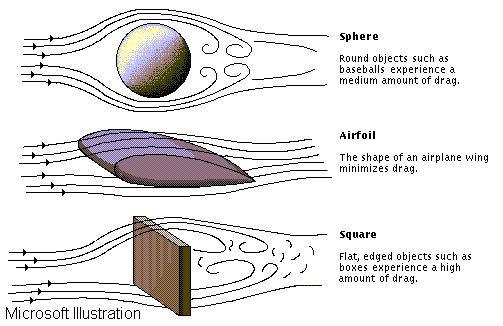
aerodynamics is the drag, or resistance, acting on solid bodies moving through
air. The drag forces exerted by the air flowing over the airplane, for example,
must be overcome by the thrust force developed by either the jet engine or the
propellers. These drag forces can be significantly reduced by streamlining the
body. For bodies that are not fully streamlined, the drag force increases
approximately with the square of the speed as they move rapidly through the air.
The power required, for example, to drive an automobile steadily at medium or
high speeds is primarily absorbed in overcoming air resistance.
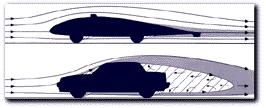
The following examples illustrate the importance of
considering drag when designing a car
Solar cells made from thin slices of crystalline
silicon, gallium arsenide, or other semiconductor materials convert solar
radiation directly into electricity. Cells with conversion efficiencies in
excess of 30 percent are now available. By connecting large numbers of these
cells into modules, the cost of photo-voltaic electricity has been reduced to 30
cents per kwh, about twice the rate that the largest U.S. cities were paying for
electricity in 1989. Current use of solar cells is limited to remote, unattended
low-power devices such as buoys and equipment aboard spacecraft.
In order to design the exterior shape of the solar car, we had to consider the previously mentioned factors, which are:
1 - The design must maximize the
amount of surface area exposed to sunlight to obtain maximum power.
2 - The design of the car must have
an aerodynamic shape to minimize the amount of drag to which the car is
exposed.
3 - The car surface
should have smooth gradual curves to have an aerodynamic body of low wind
resistance.
Solar cars have several unique shapes. The
following figure shows the most famous and well-known shapes: 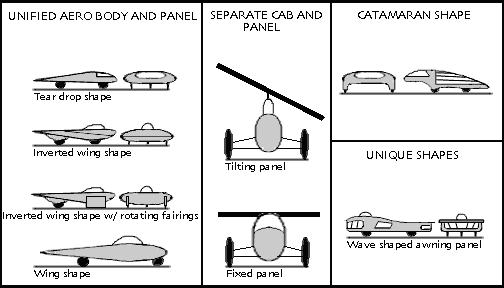
We finally decided to select the wing shape design. This is
because we have found out that most of the universities tend to design this
shape. In addition, it is perhaps the easiest one in manufacturing. In fact, our
shape was not a simple copy for that one; we introduced some
modifications.
Following is the design we
set for ourselves:
Position Length (LTR)
or Height from the ground
Entire
frame 5.8 m
Wheels 25 cm diameter,
10 cm thickness
Driver cabin height 38
cm
Full height 1.48m
Tail length 3.4m
The tail is taken to be a straight line. The cross
section of the car is taken as an ellipse of changing dimensions. Thus, the main
concern for us became the parts in the front and the driver’s cabin. Using
AutoCAD, we estimated some key points along the x-y plane, considering the left
side of the coordinates as the y-axis, and the x-axis will be the direction
along the ground.
After defining these dimensions, a rough sketch was drawn
by AutoCAD. By offsetting and dimensioning, the following values were
obtained.
X coordinate (cm) Y coordinate (cm)
20
89.7261
40
98.296
70
107.2946
90
111.0367
110
113.8179
120
115.0542
These numbers were processed into
the computer program, asking the program to:
a - get the interpolations of every x point
(with 1 cm increment from the first value).
b - get the angle of inclination of the
tangent at the point
Then the output data is used to plot the front section surface.
The same will happen with the driver cabinet. However, since the cabinet will not be covered with photo-voltaic cells, there is no need to calculate the angle of inclination.
X coordinate cm Y
- coordinate cm
120
115.0542
140
136.0397
160
149.3282
180
150.6931
200
143.0437
240
130.2249
260
115.0293
Concerning the tail, the angle of
inclination is known since it is a simple straight line relation.